



When people start talking about Intelligent Document Processing (IDP), the discussion often begins in the wrong way.
Usually, the finance team asks: “How much does it cost to process each document?”
The operations team asks: “How many people can we reduce?”
Because of this, the project is often treated as just a way to save labor costs.
But this way of thinking misses the bigger picture.
IDP is not only about reducing manual work. It can bring much larger benefits to the business.
If you are a technology leader who wants to build a strong and complete business case for IDP, this guide will help you. It explains:
- How to measure the real return on investment (ROI) from document automation.
- The true cost difference between building your own system and buying a platform.
- A simple checklist to evaluate vendors and choose the right solution.
The goal is to help teams understand the full value of modern document processing, not just the savings from reducing manual work.
Key Takeaways
- IDP ROI goes beyond labor savings: it improves speed, compliance, customer experience, and data usage.
- Operational agility matters: faster document processing helps businesses respond to demand and serve customers more quickly.
- Manual processing increases risk: IDP reduces errors and improves auditability and regulatory compliance.
- Building in-house has hidden costs: ongoing maintenance, model training, security, and scaling require long-term engineering effort.
- Vendor selection is critical: evaluate accuracy, security, integration capabilities, and whether the solution is a full platform or just OCR.
To understand the real value of IDP, we need to move beyond simple cost calculations and look at the broader business impact.
A practical way to do this is by evaluating document processing across four dimensions of value.
Redefining ROI: The Four Dimensions of Document Processing Value
The usual way people explain the value of Intelligent Document Processing (IDP) is very simple.
They say something like this:
“We process X number of documents every month. Each document takes Y minutes to handle manually. If we automate it, we will save Z amount of money in labor costs.”
This idea is not wrong, but it only shows a small part of the real value.
In reality, the benefits of IDP are much bigger than just saving employee time. Labor savings may represent only about 30% of the total value.
To understand the full impact, we need to look at four different areas of value. These four areas together create a complete ROI (Return on Investment) framework.
Each of these areas:
- Provides real business value
- Can be measured
- Grows over time as the system processes more documents
Looking at all four dimensions helps companies see the true business impact of document automation, not just the cost savings from manual work.
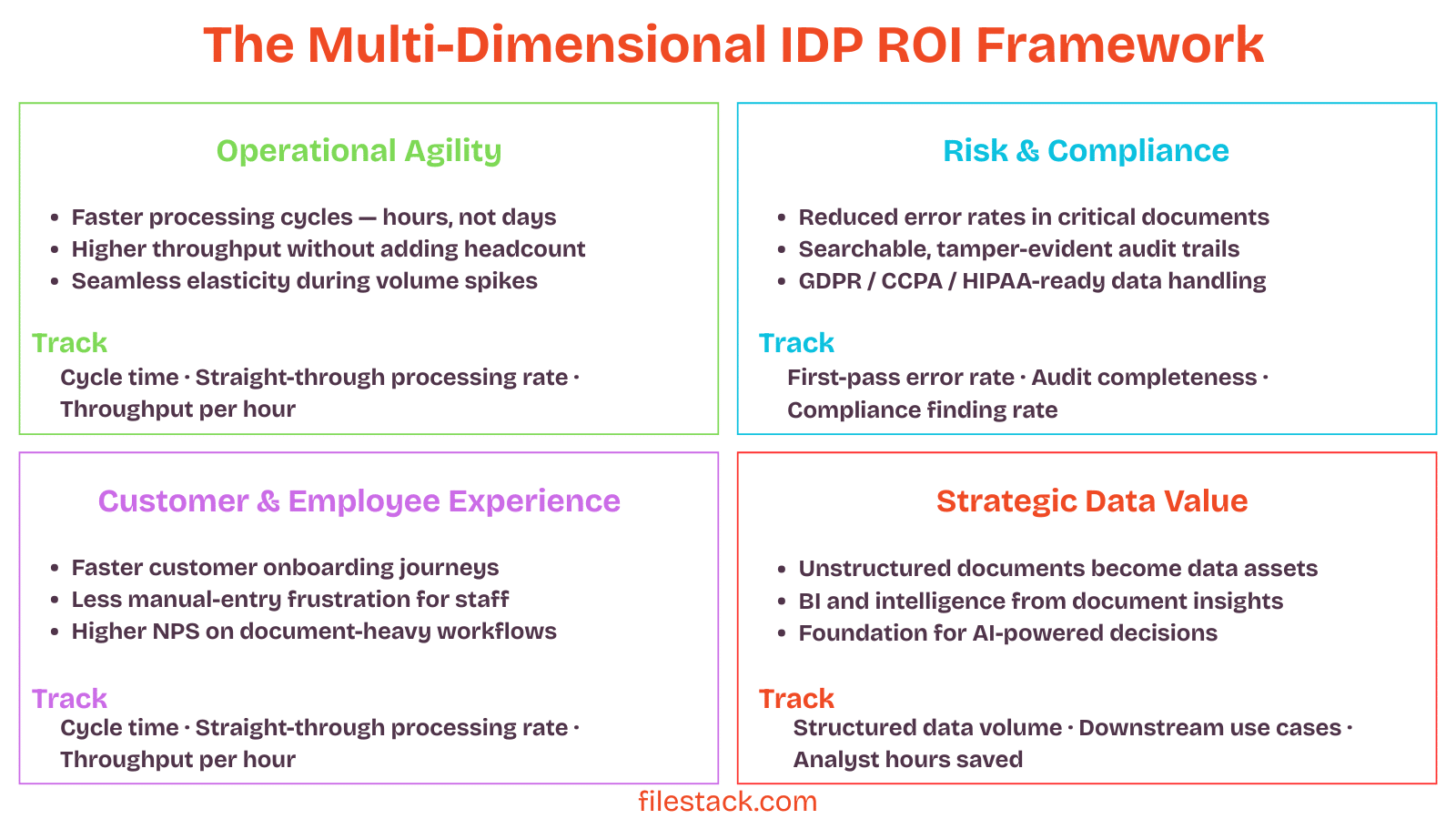

Operational Agility
Speed in document workflows is not just about convenience; it can also give a business a competitive advantage.
For example, imagine a financial services company that processes 10,000 loan applications every month.
If it reduces the processing time from five days to one day, it not only saves time and cost. It can also approve customers faster and win business while competitors are still processing applications.
This is where Intelligent Document Processing (IDP) helps.
IDP allows companies to process more documents faster without needing to hire more people. It also helps during busy periods, such as tax season, open enrollment periods, and end-of-quarter contract processing.
During these times, the ability to handle more documents quickly can mean the difference between meeting demand or losing customers.
Important metrics to measure this value include:
- Document processing cycle time: how long it takes to process a document.
- Straight-through processing rate: how many documents are completed automatically without human help.
- Throughput per hour: how many documents are processed every hour.
Speed is only one part of the value IDP provides. Another major benefit of document automation is reducing risk and improving compliance.
Risk and Compliance
Handling documents manually often leads to mistakes.
In simple situations, these mistakes may only cause small problems. But in areas like finance, legal, or healthcare, errors can create serious risks.
Studies of manual data entry show error rates typically fall in the 1–5% range, depending on the complexity of the data and the workflow involved. Even small errors can lead to expensive corrections later, problems during audits, and the risk of breaking regulations.
A properly implemented Intelligent Document Processing (IDP) system can reduce many of these mistakes. It can also create clear audit trails that are easy to search, difficult to change or tamper with and simple to report during audits.
For companies that must follow regulations such as GDPR, CCPA, or HIPAA, this type of system is very important, not just a nice feature.
Important metrics to track include:
- First-pass error rate: how many errors happen the first time data is processed.
- Audit trail completeness score: how complete and trackable the audit records are.
- Compliance finding rate: how often compliance issues are found during audits.
Beyond operational improvements and risk reduction, IDP also affects how customers and employees experience document-heavy processes.
Customer and Employee Experience
Every time a company processes documents, it also affects the experience of customers and employees.
For example, if someone applies for a mortgage and has to wait two weeks for processing, they may not wait patiently. Most people will start looking at other options.
The same happens inside a company. If new employees are delayed during onboarding because of paperwork, it can create a bad first impression of how the organisation works.
Intelligent Document Processing (IDP) helps reduce these delays.
When documents are processed faster:
- Customers can sign up or get approved more quickly.
- Businesses can increase conversions and reduce early customer drop-offs.
- Employees spend less time on repetitive data entry.
- Teams can focus on more meaningful and valuable work.
This improves both customer satisfaction and employee productivity.
Important metrics to measure this include:
- Time-to-onboard (customer): how long it takes to complete customer onboarding.
- Employee NPS (Net Promoter Score) for workflows: how employees rate their experience with document-related tasks.
- Support ticket volume related to document status: how often customers ask about the progress of their documents.
Finally, there is a longer-term advantage that many organisations overlook: the strategic value of the data inside documents.
Strategic Data Utilisation
This is a benefit that many organisations completely overlook, but over time it can become one of the most valuable advantages.
Documents are not just files; they also contain important business data. For example, pricing information, contract terms, vendor details, and compliance-related data.
The problem is that this information is usually locked inside unstructured documents like PDFs, forms, or scanned files.
An Intelligent Document Processing (IDP) platform can extract, classify, and organise this information into structured data.
When this happens, the system is not only automating a workflow. It is also creating a valuable data asset for the company.
Once document data becomes structured and searchable, businesses can use it for things like:
- Contract analysis
- Spend analysis and financial insights
- Risk monitoring
- Business intelligence and reporting
These insights can help leaders make better strategic decisions, even in areas that are not directly related to the original document process.
Important metrics to track include:
- Number of documents converted into structured data.
- New use cases created, such as BI dashboards or automated reports.
- Analyst time saved by reducing manual data collection.
Once the value of IDP is clear, the next question most teams face is how to implement it: should you build the system internally or use an existing platform?
The Hidden Costs of Building In-House
When companies consider Intelligent Document Processing (IDP), a common question comes up:
“Should we build our own system or buy an existing platform?”
For engineering teams that already have experience with OCR and machine learning, building their own solution may seem attractive. It can feel like they will have more control, and internally, it may sound reasonable to ask:
“Why should we pay a vendor if we can build it ourselves?”
But to answer this honestly, teams need to look at what “building it” really means.
It is not just about creating an initial prototype.
The real challenge is the long-term engineering effort required to build, improve, and maintain a complete system over time.

The Full Engineering Commitment
When a company plans to build its own IDP system, teams usually think only about the initial development work.
But many important tasks are often overlooked. Building a real production system requires ongoing work, such as:
- Retraining models regularly as document formats change over time.
- Supporting more formats, like new file types, low-quality images, or handwritten text.
- Improving accuracy for rare or unusual cases that appear when the system is used at large scale.
- Creating backup processing systems and failover infrastructure so the platform stays reliable.
- Engineering the system to handle sudden spikes in document volume without slowing down.
- Adding strong security protections, penetration testing, and compliance requirements.
- Building audit log systems that securely store records and make reporting possible.
In reality, the effort required is much larger than the original estimate.
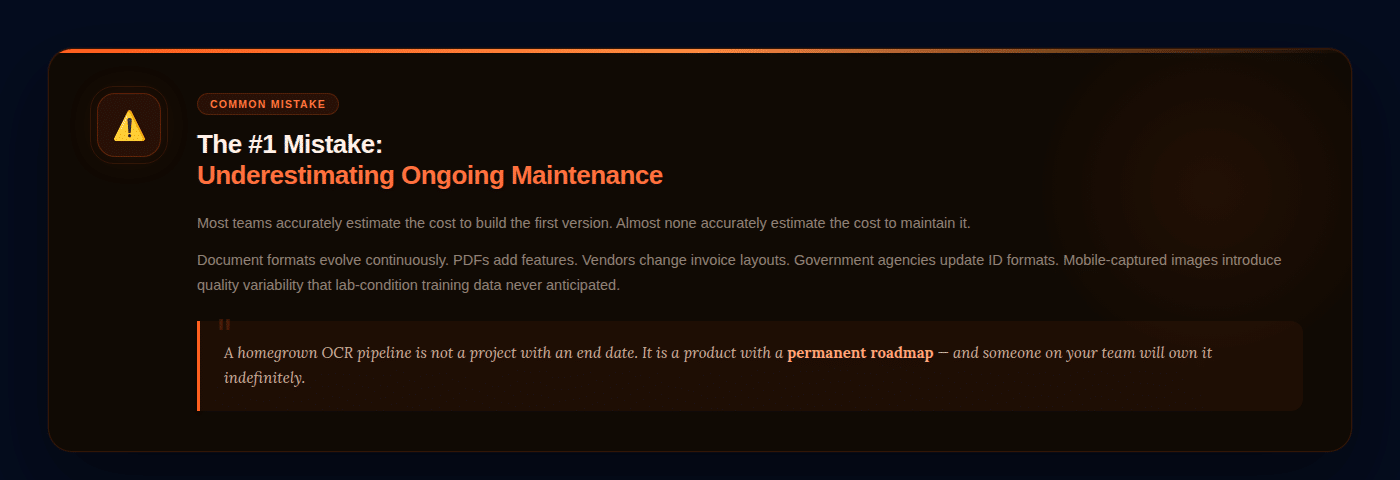
Many organisations initially assume that a small team of three engineers working for six months will be enough to build the system.
However, when companies review their real costs, they often discover that the system needs continuous support from 1–2 full-time engineers for several years to maintain and improve it.
Because of this, the long-term engineering commitment is often much bigger than teams expect.
| Cost Category | Build In-House | SaaS IDP Platform | Difference |
|---|---|---|---|
| Initial Engineering (3 developers × 6 months) | $270,000 | $0 | — |
| Ongoing Maintenance (1 FTE per year, 5 years) | $450,000 | $0 | — |
| Infrastructure & DevOps | $120,000 | Included | — |
| Security & Compliance Work | $80,000 | Included | — |
| Platform Subscription | $0 | $150,000 | — |
| Integration & Onboarding | $30,000 | $15,000 | — |
| Total 5-Year TCO | ~$950,000 | ~$165,000 | ~$785,000 saved |
Note: These numbers are only examples based on typical costs for mid-sized engineering teams. Your organisation’s actual costs may be different, depending on factors like team size, salaries, infrastructure, and project complexity. You can use this structure as a starting point to estimate the real costs for your own organisation.
The Opportunity Cost Question
The cost comparison between building and buying often misses an important factor: what your engineering team could be building instead.
If engineers spend months improving OCR models or creating compliance logging systems, they are not working on features that improve the main product or create a competitive advantage.
In other words, every month spent maintaining document processing infrastructure is a month not spent on core product innovation.
For most companies, document processing is a supporting infrastructure. It is important for operations, but it usually does not differentiate the product in the market.
Because of this, the decision between building or buying should not rely only on cost comparisons or spreadsheets. Teams should also think about engineering focus and opportunity cost.
For a complementary perspective on when specialised APIs outperform homegrown solutions, see the strategic case for leveraging specialised APIs over building in-house.
For many organisations, these hidden costs make buying a platform the more practical option. But not all IDP vendors offer the same capabilities.


The Vendor Evaluation Checklist for CTOs
Not all Intelligent Document Processing (IDP) solutions are the same. Different platforms offer different features, levels of accuracy, and integration capabilities.
Also, the things that matter most to a CTO or engineering leader are often different from what typical analyst reports focus on.
Because of this, it helps to evaluate IDP vendors using a practical framework that focuses on technical needs, reliability, and long-term value.
Below is a simple framework that can help CTOs and engineering teams choose the right solution.
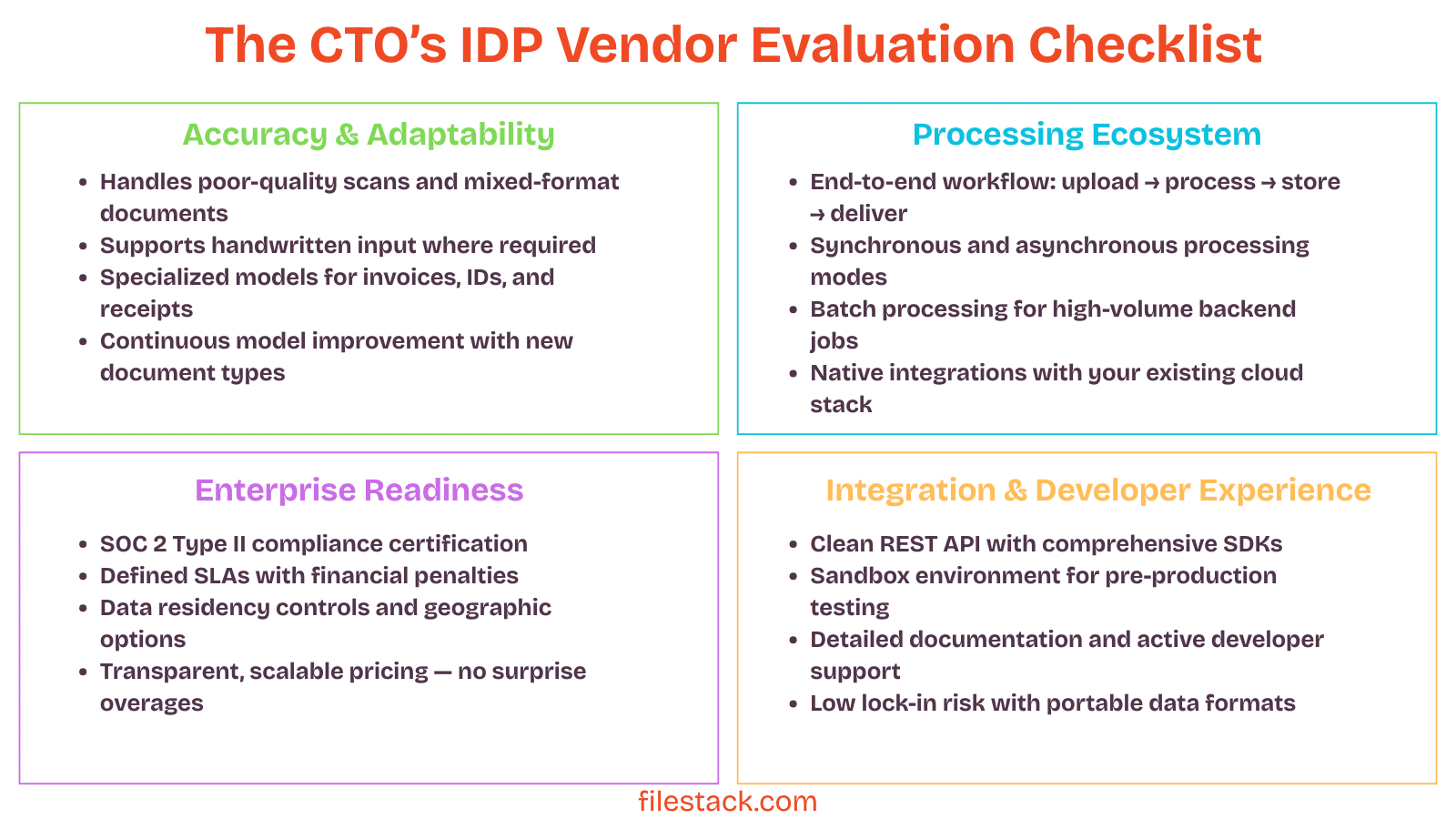
On Accuracy: What the Benchmarks Don’t Tell You
Many vendors highlight numbers like “99.5% OCR accuracy.” But these numbers can be misleading without proper context.
For example, a system might achieve very high accuracy when processing a clear, high-resolution invoice in a test environment. However, real-world documents are often very different.
In real situations, documents might be:
- Photos taken on a mobile phone
- Wrinkled or crumpled receipts
- Low-quality scans
- Documents with handwritten text
Because of this, accuracy numbers from controlled tests may not reflect real performance in production.
When evaluating vendors, it is important to ask deeper questions, such as:
- How accurate is the system when the input quality is poor or degraded?
- Which document types have specialised models (invoices, receipts, forms, contracts, etc.)?
- How does the system handle confidence scores for extracted data?
- What happens when the system is not confident about the result?
A good system should handle low-confidence situations properly by:
- Flagging the document for human review.
- Clearly showing uncertainty in the extracted data.
- Avoiding silently returning incorrect information.
For a frank discussion of accuracy challenges and how to address them, see common challenges with OCR accuracy and how to fix them.
On Ecosystem: Point Solution vs. Platform
Another important decision when choosing a vendor is understanding what you are actually buying: an OCR tool or a complete document workflow platform.
An OCR API only performs one task: it extracts text from documents.
A document workflow platform, however, manages the entire process, including file uploads, file format conversion or transformation, document processing, storage and delivering the processed data to your application
This difference is important because integration complexity grows over time.
If you use many separate services, one for uploads, another for OCR, another for storage, and another for processing, every connection between these systems creates extra latency, more possible failure points and more maintenance work for engineers.
Platforms that combine these steps into one unified system or API can reduce this complexity. They provide a single interface and service-level agreement (SLA) instead of multiple moving parts.
For more on how an integrated file workflow reduces this complexity, see our guide to getting started with Filestack Workflows.
On Security: Due Diligence That Will Save You Later
Security is very important when working with document processing systems.
Documents moving through these systems often contain sensitive information, such as personal data (PII), financial records, legal documents, and healthcare information.
Because of this, the security standards of your IDP vendor become part of your own security setup.
Before choosing a vendor, it is important to check some basic security requirements, including:
- SOC 2 Type II certification (which shows that the company follows strong security and operational controls over time).
- Data residency options, so you know where your data is stored.
- Encryption in transit and at rest, to protect data while it is moving and while it is stored.
- A clear data retention and deletion policy, explaining how long data is stored and how it is removed.
If your organisation works in a regulated industry, you should also confirm that the vendor’s compliance standards match the regulations your company must follow.
Doing this security due diligence early can prevent serious problems later.
For detailed technical due diligence on document processing security, see our complete guide to Filestack security.
On Integration: The Architectural Questions
Before choosing a vendor, your team should check whether the processing architecture fits your real use case.
A good API should support two types of processing:
- Synchronous processing: used when a user uploads a document and the result is needed immediately.
- Asynchronous processing: used for background or batch jobs, where the result can come later.
If a vendor supports only one of these options, your team may need to change the system architecture or add extra workarounds.
You should also evaluate the quality of the SDKs and documentation provided by the vendor.
These factors affect:
- How quickly your team can complete the first integration.
- How easy it is for developers to maintain and extend the system.
- How much developer friction appears over time.
Good documentation and reliable SDKs can make integration much faster and smoother.
After identifying the right platform, the next step is building a strong internal business case to secure budget and stakeholder support.
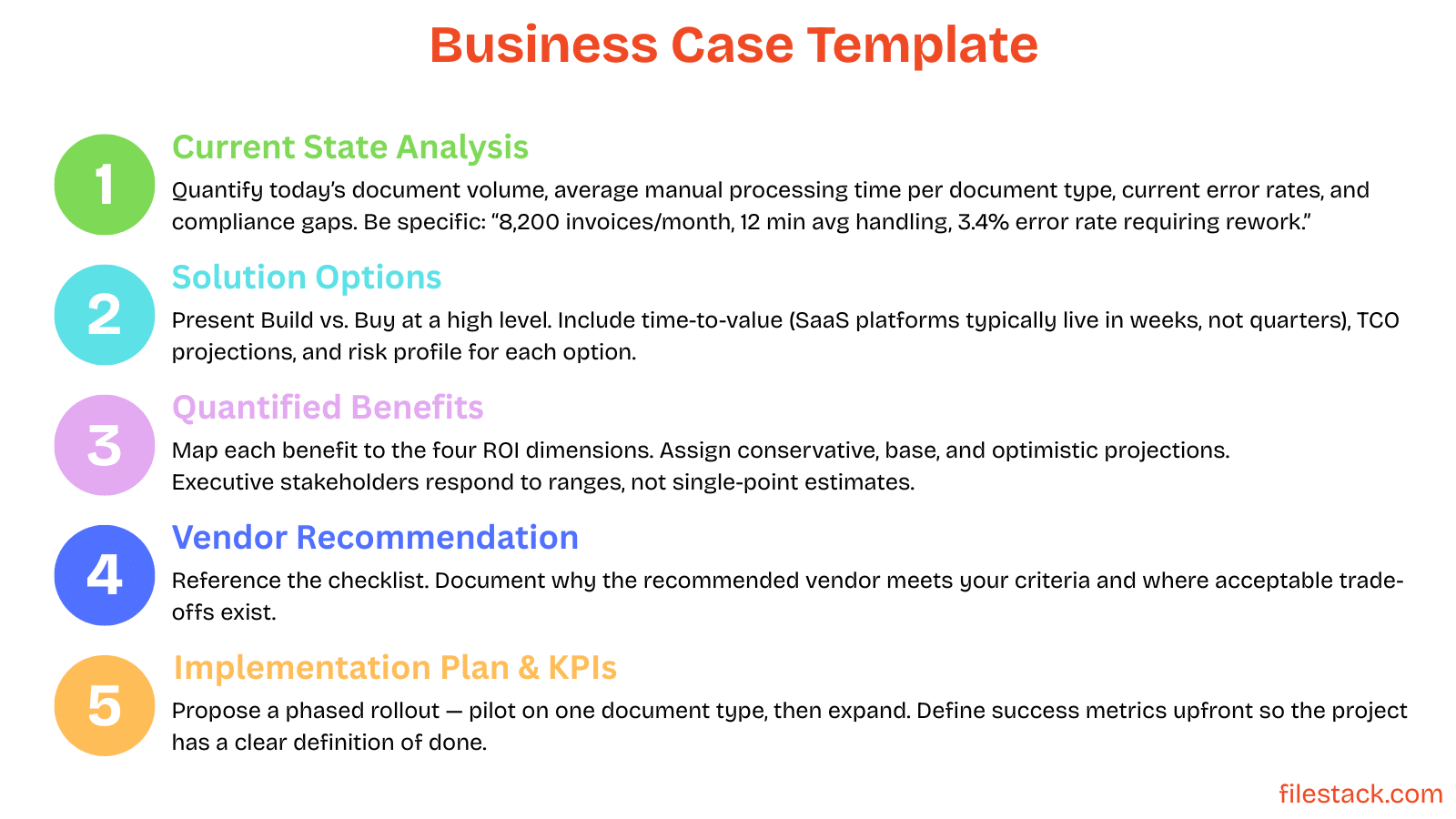
Building the Business Case: A Practical Template
Now that you understand the ROI framework and how to evaluate vendors, the next step is to turn this information into a clear business case.
A structured business case helps you explain to leadership why investing in IDP makes sense and what value the organisation will gain.
The diagram below shows a simple framework leaders can use when preparing an internal IDP business case.
The KPIs That Actually Get Tracked
Business cases are usually approved based on expected benefits. But later, projects are sometimes questioned because there are no clear metrics showing the results.
To avoid this, it is important to agree on measurable KPIs with stakeholders before launching the system.
Some useful KPIs to track include:
- Processing cycle time: the total time from when a document is received until the data becomes available.
- First-pass yield rate: the percentage of documents processed automatically without human help.
- Error rate per 1,000 documents: how many mistakes occur during processing.
- Employee satisfaction score for document-related workflows (measured through quarterly surveys).
- Time-to-onboard improvement for customer-related processes that involve documents.
- Structured data utilisation rate: the percentage of extracted document data that is actually used by other systems or teams.
These metrics should be tracked every quarter during the first year.
They provide clear evidence of the platform’s value and help support decisions about renewing the investment or expanding the system to process more document types.
When organisations evaluate ROI, choose the right platform, and track the right metrics, IDP becomes more than a workflow tool.


Closing Thought: This Is a Platform Decision, Not a Point Solution
The most important idea to remember is this: Intelligent Document Processing (IDP) is not just a small automation tool.
When implemented correctly, it becomes core infrastructure for the organisation. Almost every department deals with documents: contracts, invoices, forms, applications, reports, and more.
Because of this, an IDP system often supports many future initiatives, not just one workflow.
This means the decision you make today will likely shape how your organisation handles documents for many years. That is why choosing the right vendor matters. Important factors include:
- Vendor stability
- Strength of the ecosystem and integrations
- Security standards
- Quality and reliability of the API
When building your internal proposal, make sure you present the complete value of IDP. Use the four ROI dimensions discussed earlier and evaluate vendors using a clear checklist.
Most importantly, avoid presenting the investment only as a way to reduce headcount. The real value is much bigger: improving operations, reducing risk, enhancing customer and employee experience, and unlocking useful data from documents.
Platforms that provide strong APIs, reliable infrastructure, and flexible document processing capabilities can make this transition much easier. Among many tools available, Filestack is one option teams explore when they need a developer-friendly way to handle document uploads, processing, and delivery within their applications.
Ready to explore Filestack for your Intelligent Document Processing (IDP) needs? You can review the documentation to see supported document types and capabilities, and evaluate whether it fits your organisation’s volume, security, and compliance requirements.


Shefali Jangid is a web developer, technical writer, and content creator with a love for building intuitive tools and resources for developers.
She writes about web development, shares practical coding tips on her blog shefali.dev, and creates projects that make developers’ lives easier.