



File uploads are a core part of almost every modern app, whether it’s profile pictures, document uploads, media sharing, or onboarding forms. Earlier, most teams simply created their own upload endpoint, connected it to an S3 bucket, and called it a day. For smaller apps, that worked well.
But in 2026, things are different.
Modern apps are used across different countries, devices, and network conditions. Because of that, building a reliable upload system has become much more complicated. What starts as a simple upload feature can quickly turn into handling CDN setup, retry logic, malware scanning, mobile upload issues, and server maintenance, all of which take time away from building actual product features.
That leads to an important question: should your team use a file upload API or build a self-hosted upload server?
The right choice depends on your app’s scale, your team size, and how much engineering time you want to spend managing uploads yourself.
Key Takeaways
- File upload APIs handle scaling, reliability, and CDN delivery for you, while self-hosted servers require you to manage everything yourself.
- Self-hosted uploads may seem cheaper, but costs like maintenance, CDN setup, and fixing issues add up quickly.
- Upload APIs include built-in security features like signed URLs and file validation by default.
- Managed APIs provide better mobile upload support with features like resumable uploads and faster delivery.
- Self-hosted uploads are best only for teams with very specific needs and strong infrastructure support.
To understand which option is better, let’s first understand what a file upload API actually is.
What Is a File Upload API?
A file upload API is a cloud service that helps developers handle file uploads without managing the infrastructure themselves.
Instead of building and maintaining your own upload system, your app simply connects to the API. The service then takes care of uploading files, storing them, speeding up delivery with a CDN, and even triggering actions after uploads are complete.
Definition of a File Upload API
At its simplest, a file upload API is a managed service that lets developers handle uploads through HTTP APIs instead of building the infrastructure themselves.
Your app connects to the API, and the provider handles everything in the background: servers, storage, CDN delivery, and upload reliability.
Filestack is built specifically for this: a single integration gives you upload acceleration, resumable transfers, multi-source support (local files, cloud storage, URLs), and a globally distributed delivery layer.
Features Commonly Included in Upload APIs
Most modern file upload APIs come with useful built-in features like:
- Resumable uploads: Uploads continue even if the internet connection drops.
- Global CDN support: Faster uploads and downloads using servers closer to users.
- Cloud storage integration: Direct uploads to services like S3, GCS, or Azure Blob.
- Upload security: Signed URLs and access controls for safer uploads.
- File processing: Image resizing, file conversion, and format optimisation.
- Webhooks: Instant notifications when uploads succeed or fail.
Typical Use Cases for Upload APIs
File upload APIs work especially well for SaaS apps with user-generated content, mobile apps with unstable internet connections, media platforms handling large uploads, marketplaces managing seller files, and collaboration tools where reliable uploads are important for user experience.
On the other hand, self-hosted upload servers come with a very different set of challenges and responsibilities.
What Is a Self-Hosted Upload Server?
A self-hosted upload setup means your team is responsible for the entire upload system, from receiving files and storing them to managing CDN delivery, security, monitoring, and overall reliability.
Definition of a Self-Hosted Upload Architecture
In a self-hosted setup, your team handles everything inside your own infrastructure. Developers need to build the upload logic, manage storage and permissions, configure CDNs, and create systems for retries and error handling.
This gives you full control over the upload process, but it also means your team is fully responsible for keeping everything secure, reliable, and running smoothly.
Components Teams Typically Manage Internally
Self-hosted upload systems require your team to manage everything, including upload endpoints, storage setup, CDN configuration, security rules, file processing, and system monitoring. Your team is also responsible for handling failures, alerts, and ongoing maintenance.
Why Teams Choose Self-hosted Uploads
Teams usually choose self-hosted uploads when they have very specific needs, like custom file processing workflows, strict data or deployment requirements, or an existing internal infrastructure platform. These are valid reasons, but they only apply to a smaller number of companies than many teams expect.
Once you look at the real setup and maintenance involved, the difference between the two approaches becomes much clearer.
Infrastructure Complexity Comparison
The biggest difference between self-hosted and managed uploads comes from infrastructure. Building a simple upload endpoint may seem easy at first, but running it reliably in production becomes much more complicated over time.
File Upload APIs Abstract Infrastructure Management
Managed APIs like Filestack are built to handle the complex parts of file uploads for you. They automatically scale as upload traffic grows, deliver files faster through global CDNs, and include reliability features like retries and failover by default.
Instead of building and maintaining these systems yourself, your team can simply use the API and focus on product development.
Self-hosted Upload Servers Require Ongoing Operations
When you manage your own upload infrastructure, scaling becomes an ongoing engineering challenge. Your team needs to monitor storage, handle traffic spikes, and manage scaling as usage grows.
For global apps, things get even more complex because multi-region deployments require careful setup across storage, CDN, and networking systems.
Hidden Infrastructure Challenges Teams Underestimate
Self-hosted upload systems also come with many hidden challenges. Your team needs to handle failed or interrupted uploads, support large file transfers without timeouts, ensure reliable uploads on unstable mobile networks, and deal with browser compatibility issues.
All of these problems can be solved, but solving and maintaining them takes significant engineering time.
| Feature | Managed API | Self-Hosted |
| Scaling | Automatic scaling | Team responsibility |
| CDN Delivery | Built-in global CDN | Team responsibility |
| Retry Logic | Included by default | Team responsibility |
| Mobile Upload Support | Resumable uploads & reliability | Team responsibility |
| Security | Signed URLs & access controls | Team responsibility |
| Monitoring & Alerts | Managed by the provider | Team responsibility |
Infrastructure is only one part of the decision. Performance and scalability matter just as much.
Scalability and Performance Tradeoffs
As upload traffic grows, weaknesses in upload systems become much easier to notice. This is where the difference between managed APIs and self-hosted infrastructure becomes especially clear.
Upload APIs are Designed for Unpredictable Scale
Managed upload platforms are designed to handle changing and high upload traffic automatically. Whether it’s a product launch, viral traffic, or seasonal spike, the system scales without your team needing to step in.
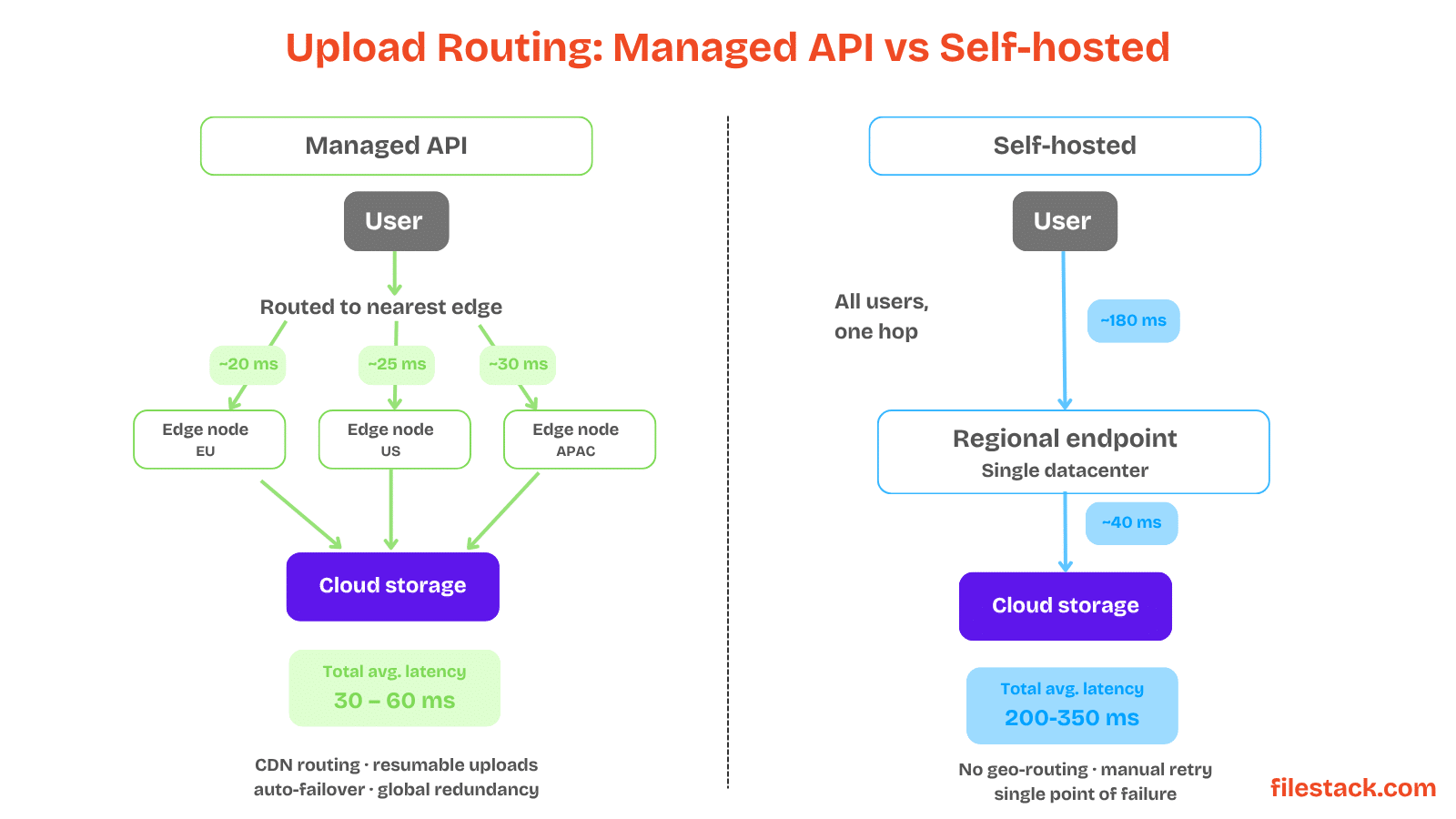
They also improve performance for global users through built-in CDN routing, so your team doesn’t have to manage servers in different regions.
Self-hosted Systems Often Struggle with Scaling Complexity
Self-hosted upload systems often run into performance issues at the storage or processing level as traffic grows. Users who are far from your servers may also experience slower uploads because of regional latency.
Many teams also overlook CDN optimisation for uploads, even though it plays a big role in upload speed and reliability.
Performance Features Modern Upload Systems Require
Modern upload systems in 2026 need features like chunked uploads for large files, parallel transfers for faster speeds, edge routing for lower latency, and resumable uploads for interrupted connections.
These features are now expected for a good user experience, but building them reliably requires significant engineering effort.
To better understand, here’s a visual diagram of how uploads are routed in both approaches:

As upload systems grow, security becomes another major factor teams need to consider.
Security Comparison Between Managed APIs and Self-Hosted Uploads
File uploads are one of the biggest security risks in modern web applications. That’s why choosing between a managed API and a self-hosted system is an important security decision, not just an infrastructure one.
File Uploads Create Major Security Risks
Every file upload endpoint can become a target for attacks. Common risks include malware uploads, fake file types disguised as safe files, oversized uploads that overload servers, and unauthorised uploads from unknown users.
These are not rare problems; they are common attack methods used against apps that support file uploads.
Security Responsibilities with Self-hosted Infrastructure
In a self-hosted setup, your team is responsible for everything related to upload security. This includes validating file types, scanning files for malware, managing storage permissions, setting access controls, limiting upload abuse, and maintaining audit logs.
Each of these systems must be built, tested, and regularly updated as security threats continue to change.
Security Features Commonly Included with Upload APIs
Managed upload APIs usually include built-in security features like expiring signed upload URLs, file validation, secure cloud storage integrations, and provider-managed infrastructure security.
Filestack, for example, handles signed URL generation and storage permission management as part of the standard integration, security features that would take significant time and effort to build in a self-hosted setup.
Security is important, but cost also plays a big role in choosing the right upload solution.
Cost Comparison in 2026
The cost comparison between managed APIs and self-hosted uploads is often misunderstood. Self-hosted systems may seem cheaper at first, but the real cost usually shifts to engineering time, maintenance, monitoring, and operational work.
Self-hosted Uploads Involve More than Storage Costs
Running your own upload infrastructure also brings ongoing costs like engineering time, CDN expenses, monitoring tools, server maintenance, and security updates.
There’s also the hidden cost of developers spending time managing upload systems instead of building product features and improving the user experience.
Managed Upload APIs Reduce Operational Overhead
A managed upload API turns much of the maintenance and infrastructure work into a predictable usage-based cost. Setup is much faster, maintenance is reduced, and scaling costs grow only as your actual usage increases instead of paying for extra infrastructure in advance.
Hidden Costs Teams Often Overlook
The hidden costs of self-hosted upload systems often surprise teams. These include building reliable retry and recovery systems, handling browser compatibility issues, optimising uploads for unstable mobile networks, and dealing with production incidents when uploads suddenly fail.
Over time, maintaining all of this can consume far more engineering effort than expected.


Beyond infrastructure costs, developer experience can also affect how quickly teams ship products.
Developer Experience and Integration Speed
Developer experience matters. Every hour engineers spend maintaining upload infrastructure is time they could spend building features that improve and differentiate the product.
Upload APIs Accelerate Implementation
Managed upload APIs usually come with SDKs for popular languages and frameworks, ready-made upload UI components, and clear documentation that speeds up integration.
Filestack even provide prebuilt file picker and upload widgets with features like drag-and-drop, progress tracking, and multi-file uploads, saving teams weeks of frontend development work.
Self-hosted Solutions Require More Custom Development
Building a self-hosted upload system means creating everything yourself: frontend upload logic, reliable retry systems, upload authentication, and file processing features like image resizing or format conversion.
While all of this is possible to build, it also needs continuous testing, maintenance, and updates over time.
Why Developer Productivity Matters
The maintenance work also grows over time. Browser updates, mobile OS changes, or CDN configuration updates can all create new issues in a self-hosted upload system.
Managed APIs handle most of these infrastructure changes for you, so your integration continues working without your team constantly monitoring and fixing compatibility problems.
Fast integration is valuable, but long-term reliability matters just as much.
Reliability and Operational Maintenance
Upload reliability has a direct impact on user experience. When uploads fail, users often can’t complete their task, and those bad experiences are difficult to forget.
Upload Systems Fail in Unpredictable Ways
Upload systems can fail in many ways that are difficult to predict and reproduce. Internet connections may drop during uploads, large files can time out, browsers may crash, and mobile apps can get interrupted by calls or background restrictions.
Handling these situations smoothly requires careful engineering and reliable recovery systems.
Managed Upload APIs Include Reliability Tooling
Filestack includes built-in features like automatic retries, resumable uploads, multi-region failover, and real-time monitoring dashboards.
These systems are designed by teams that manage upload infrastructure at a large scale, helping applications maintain reliable uploads even when network or infrastructure issues happen.
Operational Responsibilities with Self-hosted Infrastructure
Running self-hosted uploads also means your team is responsible for production support when uploads fail, handling incidents, optimising performance as traffic grows, and planning infrastructure capacity in advance.
For teams without dedicated infrastructure engineers, managing all of this can become a major long-term responsibility.
Another major challenge in modern upload systems is mobile performance and reliability.
Mobile Upload Considerations in 2026
Mobile is now a primary platform for many applications. In 2026, a large portion of file uploads comes from mobile devices, and mobile uploads bring challenges that are very different from desktop uploads.
Mobile Uploads Introduce Unique Challenges
Mobile networks are naturally unstable. Users may switch between WiFi and cellular, lose signal during uploads, or have uploads interrupted when apps move to the background.
Mobile devices also have limited resources, and operating systems often pause background processes, making reliable mobile uploads much harder to handle than desktop uploads.
Features Mobile Upload Systems Require
Reliable mobile uploads need features like resumable uploads that continue after network interruptions, smart retry systems that adapt to connection changes, file compression to reduce upload size, and efficient transfers that save battery and mobile data.
Why Upload APIs Often Outperform Self-hosted Systems on Mobile
Managed upload APIs are built to handle mobile uploads more reliably than most self-hosted systems. Features like global edge delivery help reduce latency on slower mobile networks, while resumable uploads and recovery systems are already built into the platform.
Instead of creating these complex mobile upload features from scratch, teams can use them out of the box through services like Filestack.
Even with these challenges, self-hosted uploads can still make sense in certain situations.
When a Self-Hosted Upload Server Makes Sense
Self-hosted uploads can be the right choice in certain situations. They are not the best option for every team, but they are also not always the wrong choice.
Organisations with Highly Specialised Requirements
Teams may choose self-hosted uploads when they have strict deployment policies, data sovereignty requirements that limit third-party services, or custom processing workflows that standard upload APIs cannot fully support.
Teams with Dedicated Infrastructure Engineering Resources
Self-hosted uploads are easier to manage when a company has a dedicated DevOps or platform engineering team with experience in CDN management, storage systems, and monitoring tools.
The important part is having a dedicated team; managing upload infrastructure is usually too large and complex to handle as a side task for product engineers.
Scenarios Where Complete Infrastructure Control Matters
Self-hosting also makes sense for companies that need deep integration with internal systems, highly customised upload workflows, or strict compliance requirements that need complete visibility and control over the infrastructure.
For many other teams, however, managed upload APIs are often the more practical option.
When a File Upload API Is the Better Choice
For most teams building modern applications in 2026, using a managed file upload API is usually the best and simplest choice.
Fast-growing SaaS and Product Teams
Teams that focus on building product features instead of managing infrastructure can launch faster with a managed upload API. The provider handles the operational work, while developers can spend more time improving the product.
Applications Handling Large or Global Upload Traffic
Media-heavy apps, mobile-first products, and applications with global users benefit greatly from the CDN infrastructure and global edge delivery provided by managed upload APIs.
Building the same level of infrastructure internally can take months of engineering work and requires ongoing maintenance afterwards.
Teams Focused on Product Differentiation
The time spent building and maintaining a self-hosted upload system could instead be used to build features that make your product stand out.
For most teams, upload infrastructure is not a competitive advantage; it’s simply something that needs to work reliably so developers can focus on creating better user experiences and product features.
If you decide to use a managed API, the next step is knowing what features to look for.
What to Look for in a File Upload API in 2026
Not all file upload APIs provide the same features or reliability. Here are the key things to consider when choosing one.
Core Upload Infrastructure Capabilities
Look for features like global CDN acceleration, resumable uploads, parallel transfers for large files, and direct integration with your preferred cloud storage provider. These are essential features that any reliable file upload platform should support.
Developer Experience Features
You should also check for SDK support for your tech stack, ready-made upload UI components, flexible APIs, and webhook support for async workflows.
A good developer experience is just as important as the underlying infrastructure.
Security and Scalability Requirements
You should also evaluate the platform’s authentication system, access controls, uptime reliability, and monitoring features. Signed URLs are now the standard for secure uploads.
If you work in a regulated industry, check for compliance certifications and audit logging support as well.
This is where platforms like Filestack stand out for modern product teams.
How Filestack Simplifies Modern File Upload Infrastructure
Filestack is designed to solve common upload challenges for modern product teams, including global file delivery, reliable mobile uploads, developer-friendly integrations, and built-in security, all without requiring teams to manage the infrastructure themselves.
Features Developers Need for Scalable Upload Workflows
Filestack uses a globally distributed CDN to speed up uploads and reduce latency for users around the world. It also supports uploads from local devices, cloud storage services, and URLs through a single API.
Features like resumable uploads automatically recover interrupted transfers, helping deliver a level of upload reliability that is difficult to achieve with most self-hosted systems.
How Filestack Improves Developer Experience
Filestack also provides a ready-to-use file picker with features like drag-and-drop uploads, multi-file selection, upload progress tracking, and support for multiple file sources, all customisable to match your app’s design.
It also includes APIs and SDKs for major languages and frameworks, along with built-in workflow automation for tasks like image resizing, document conversion, and metadata extraction without requiring extra infrastructure.
Benefits of Choosing Managed Upload Infrastructure
Teams using Filestack can usually integrate file uploads much faster, often in days instead of weeks. It also reduces maintenance work because Filestack handles infrastructure updates, browser compatibility issues, and CDN optimisation.
As a result, upload reliability improves, and engineering teams can spend more time building product features instead of maintaining upload infrastructure.
At this point, the tradeoffs between managed APIs and self-hosted systems become much clearer.


Conclusion
The choice between a file upload API and a self-hosted upload server mostly comes down to who handles the complexity. Self-hosting does not remove the difficult parts of upload infrastructure; it simply makes your team responsible for managing them.
For companies with very specific requirements, strict deployment rules, and dedicated infrastructure teams, self-hosting can make sense. But for most SaaS products, mobile apps, and media platforms, a managed file upload API like Filestack is usually the faster, more reliable, and more cost-effective option.
The real goal is not to avoid complexity completely, but to focus engineering time on building features that make your product unique. For most teams, upload infrastructure is not that differentiator; it simply needs to work reliably.
If your team is comparing solutions, Filestack’s file upload API is worth considering for its developer experience, reliability, security, and global upload infrastructure without the maintenance burden of running everything yourself.
Ready to reduce upload infrastructure work? Start with Filestack and give your app reliable file uploads, secure handling, global delivery, and developer-friendly tools without managing every layer in-house.
Before wrapping up, here are answers to some common questions teams have about file upload infrastructure.
FAQs
What is a file upload API?
A file upload API is a managed cloud service that handles file uploads, storage, CDN delivery, and file processing through APIs and SDKs. Teams integrate it like any third-party service, while the provider manages the infrastructure behind it.
What is a self-hosted upload server?
A self-hosted upload server is a file upload system your team builds and manages internally, including upload endpoints, storage, CDN setup, security, and monitoring.
Which is cheaper: managed uploads or self-hosted infrastructure?
The total cost is often lower with managed APIs when you include engineering time, CDN expenses, monitoring tools, security management, and incident handling. Self-hosted systems may have lower direct infrastructure costs, but they usually require much more ongoing maintenance and operational work.
What are the biggest challenges of self-hosted uploads?
The biggest challenges include handling traffic spikes, maintaining reliable mobile uploads, supporting resumable transfers, managing security features like malware scanning and file validation, and keeping the system updated as browsers and operating systems change.
How do resumable uploads improve reliability?
Resumable uploads save progress during file transfers, so if an upload is interrupted, it can continue from where it stopped instead of restarting. This is especially important for large files and mobile users with unstable connections.
Why do upload APIs use CDN acceleration?
CDN acceleration sends upload traffic through edge servers closer to users, reducing travel distance for data and improving upload speed and reliability, especially for global users.
Are managed upload APIs secure?
Yes, modern upload APIs include features like signed URL authentication, file validation, access controls, and secure storage permissions. In many cases, they provide stronger default security than custom self-hosted systems.
When should teams self-host uploads?
Self-hosted uploads make sense when you have strict data residency requirements, highly custom processing workflows, and a dedicated infrastructure team to manage the system and ongoing maintenance.
What features should a modern upload system include?
Important features include resumable uploads, CDN acceleration, parallel transfers, cloud storage integrations, file validation, signed URL security, event webhooks, and mobile-optimised upload handling.
How can developers improve file upload performance in 2026?
Use chunked and parallel uploads for large files, support resumable uploads, route traffic through nearby CDN edge servers, and compress files before uploading when needed. Managed upload APIs like Filestack handle most of this automatically.


Shefali Jangid is a web developer, technical writer, and content creator with a love for building intuitive tools and resources for developers.
She writes about web development, shares practical coding tips on her blog shefali.dev, and creates projects that make developers’ lives easier.